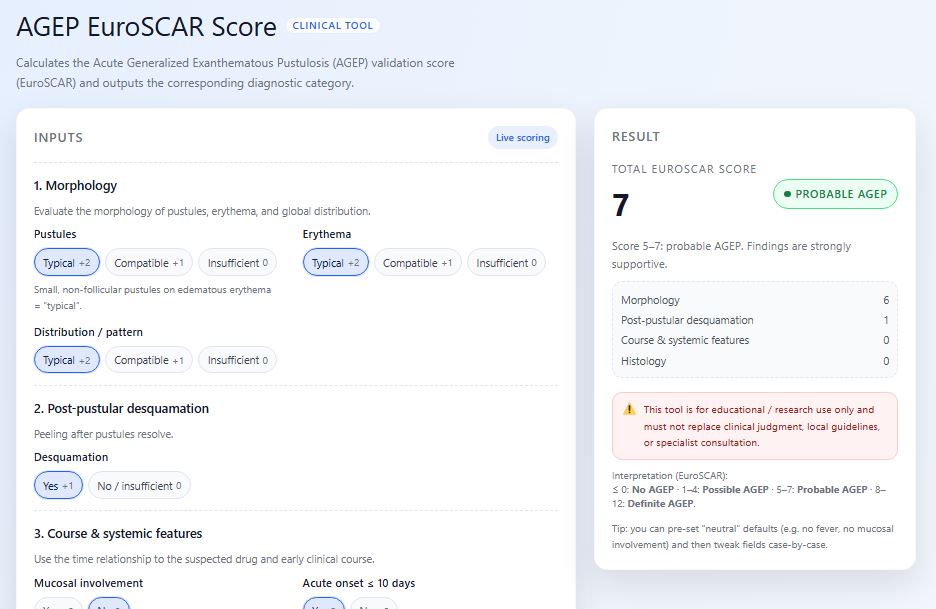
AGEP EuroSCAR Score Clinical tool
Calculates the Acute Generalized Exanthematous Pustulosis (AGEP) validation score (EuroSCAR) and outputs the corresponding diagnostic category.
How to Use the AGEP EuroSCAR Score
This tool applies the EuroSCAR validation score for Acute Generalized Exanthematous Pustulosis (AGEP).1 By combining key clinical features, timing and systemic findings, and histopathology, it generates a total score categorized as no, possible, probable, or definite AGEP. This calculator is provided for educational purposes only; I cannot guarantee that it is free of errors, and clinicians should always refer to the original EuroSCAR publication and apply clinical judgment when using this tool in real-world practice.
1. Morphology
Assess three independent features at presentation: pustules, erythema, and distribution. Score each separately as Typical, Compatible, or Insufficient.
Pustules
Typical (+2): Numerous small (<5 mm), non-follicular, superficial pustules on edematous erythema, with sudden onset and possible confluence.
Compatible (+1): Pustules present but not classic (e.g., fewer, larger, partially follicular, or limited extent).
Insufficient (0): Pustules absent, very sparse, obscured, or not assessable.
Erythema
Typical (+2): Diffuse, bright red, edematous erythema clearly associated with pustules.
Compatible (+1): Erythema present but less intense, patchy, or atypical.
Insufficient (0): Minimal, absent, or poorly documented erythema.
Distribution / pattern
Typical (+2): Generalized, symmetric eruption, often starting on face, intertriginous areas, or trunk, with rapid spread.
Compatible (+1): Suggestive distribution but limited extent or atypical initial site.
Insufficient (0): Distribution unclear, localized only, or undocumented.
2. Post-pustular Desquamation
Yes (+1): Characteristic superficial peeling after pustule resolution.
No / insufficient (0): No desquamation observed or follow-up insufficient.
3. Course and Systemic Features
Mucosal involvement — Yes (−2): Clinically relevant oral, ocular, or genital lesions; No (0): Absent.
Acute onset ≤ 10 days — Yes (0): Eruption begins within 10 days of the suspected trigger; No (−2): Latency >10 days.
Resolution ≤ 15 days — Yes (0): Clinical resolution within 15 days; No (−4): Persistent beyond 15 days.
Fever ≥ 38.0 °C — Yes (+1): Documented fever at or near onset; No (0).
Neutrophilia — Yes (+1): Neutrophils ≥ 7,000 / mm³; No (0).
4. Histology (if biopsy performed)
Select the single best overall interpretation.
Other disease (−10): Histology clearly supports an alternative diagnosis (e.g., pustular psoriasis, infection, SJS/TEN).
Not done / not representative (0): No biopsy or inadequate sample.
Neutrophil exocytosis (+1): Neutrophils migrating into epidermis without well-formed pustules.
Compatible pustules (+2): Subcorneal or intra-epidermal pustules compatible with AGEP but not classic; papillary dermal edema may be absent.
Classic AGEP pattern (+3): Spongiform subcorneal and/or intra-epidermal pustules with papillary dermal edema, often with mixed perivascular infiltrate.
About This Tool
I was inspired to build this tool when I couldn’t find one by googling. I was tired of calculating this by hand. I expect this page will be obsolete if it ever gets added to MDCalc.
- Tetart F, Walsh S, Milpied B, et al. Acute generalized exanthematous pustulosis: European expert consensus for diagnosis and management. J Eur Acad Dermatol Venereol. 2024;38(11):2073-2081. doi:10.1111/jdv.20232 ↩︎