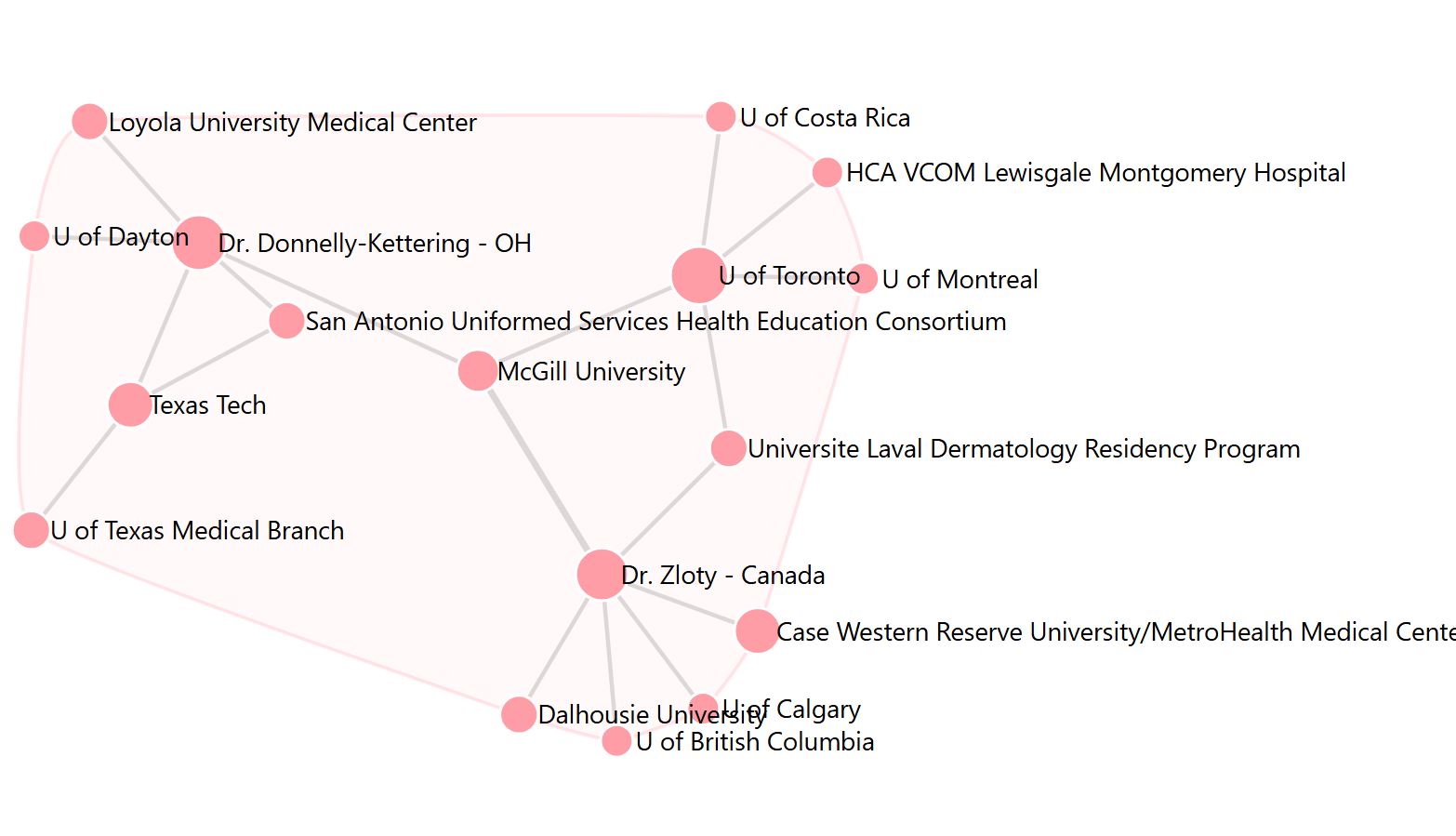
How this viewer works: choose a Mohs fellowship from the dropdown above and the diagram will redraw to show every dermatology residency that has sent a fellow into that specific program. You can drag circles to tidy the view and scroll to zoom. Use the buttons to enable second and third order connections.
About this page: This interactive tool visualizes the pathways between dermatology residency programs and Mohs micrographic surgery fellowships in the United States, using match data from 2019 through 2025. Each node represents a program, and each edge shows the movement of graduates from a residency program into a specific fellowship, providing a clear, intuitive snapshot of national training flows in Mohs surgery.
You can select any fellowship program using the dropdown menu to focus the network view, displaying all the residency programs that have sent graduates to that fellowship. Edge thickness corresponds to the number of fellows who have followed that path, while loops around a node represent graduates who matched into the same institution for fellowship (here, thicker lines mean more internal matches). This design allows you to see which fellowships have historically matched internal candidates and which fellowships attract trainees from across the country.
This helps uncover the geographic and institutional dynamics of the Mohs fellowship pipeline, whether you are a resident planning your path, a program director advising applicants, or simply interested in understanding training flows in procedural dermatology.
The network intentionally limits second and third-order connections to simplify visualization. Residency programs are displayed when they connect directly back to the main node, but their additional connections to other fellowship programs are not shown. This focuses the graph on relationships most relevant to the selected institution
Under the hood, the app uses a force-directed network graph built with D3 v7.
Community Analysis
Community Detection Overview
To identify clusters of closely related fellowship programs, we applied a network analysis technique called community detection. The goal is to find groups of programs that are more tightly connected to one another than to the rest of the network, in other words to uncover natural clusters within the training landscape.
We used a greedy modularity optimization algorithm. This algorithm starts by assigning each node to its own community and then repeatedly merges groups that increase the network’s overall modularity, which is a measure of how much more densely connected nodes are within communities compared to between them. The process stops when no further merges improve modularity, resulting in a set of communities that maximize internal connectivity. Our analysis produced 13 such communities with a modularity score of approximately 0.47, indicating a moderately strong structure where programs form distinct but interlinked clusters.
Interpreting the Results
In practical terms, each detected community represents a cluster of fellowship programs that share many direct or indirect affiliations. These clusters may reflect geographic regions, relationships between program directors, or mentorship lineages within Mohs surgery training. Programs in the same community likely share stronger academic or professional ties, while those that connect different communities may serve as bridges in the broader fellowship network.